• Home
  • Books
  • Contact Us
  • Blog
  • Videos
  • Testimonials
  • About
  • More
    • Home
    • Books
    • Contact Us
    • Blog
    • Videos
    • Testimonials
    • About
  • Home
  • Books
  • Contact Us
  • Blog
  • Videos
  • Testimonials
  • About

About Real World Statistics

Our Philosophy

Real World Statistics: A Student’s Guide to Understanding and Using Data is a complete instructional system designed to help students develop statistical reasoning, interpret evidence, and understand how data shape decisions in the world around them.


Rather than treating statistics as a collection of formulas and procedures, the curriculum helps students understand:

  • how data are collected and represented 
  • how statistical methods answer questions 
  • how conclusions should be interpreted 
  • how evidence can be evaluated and communicated 


Statistics is not only about calculating answers. It is about learning how to reason with evidence.

Developing Rigorous Statistical Thinkers

Real World Statistics is designed around the belief that statistical rigor comes from understanding, reasoning, and application—not simply from performing calculations.


Throughout the curriculum, students move beyond learning procedures to applying statistical ideas in authentic contexts. Section-based enrichment tasks place students in the role of statisticians, asking them to analyze data, evaluate models, interpret evidence, justify conclusions, and communicate findings.

Students practice the kinds of reasoning used by statisticians:


  • determining whether a statistical method is appropriate 
  • interpreting results in context 
  • evaluating the strengths and limitations of statistical models 
  • distinguishing correlation from causation 
  • supporting decisions with evidence 
  • communicating statistical conclusions clearly 


For example, students do not simply calculate regression models. They evaluate whether models are appropriate for prediction, analyze residuals to understand model accuracy, and consider what additional factors may influence real-world outcomes.

When studying statistical inference, students move beyond calculating test statistics and p-values. They evaluate claims, interpret evidence, consider practical significance, and make recommendations based on data.


The goal is not only statistical proficiency. The goal is statistical thinking.

A Connected Learning System

Real World Statistics combines:

  • full-color textbook 
  • video-supported lessons 
  • guided practice 
  • authentic datasets 
  • technology support 
  • enrichment tasks 
  • worked solutions 
  • teacher resources 


Together, these components create a coherent instructional system in which every resource reinforces the others. Students encounter ideas through multiple representations, revisit concepts across lessons, and gradually build the confidence to investigate authentic data independently.


Every section follows the same learning progression:


Understand the concept → Practice the skill → Think like a statistician → Apply learning to authentic data


The Teacher Toolkit supports implementation with:

  • section-by-section teacher slides 
  • guided notes 
  • assessments 
  • pacing guides 
  • dataset investigation guides 


Designed for high school statistics, dual-enrollment, homeschool, and introductory college settings, Real World Statistics develops the reasoning habits emphasized in advanced statistics courses.

From Learning Statistics to Doing Statistics

Developing statistical reasoning requires more than isolated lessons or disconnected projects. Real World Statistics is intentionally designed to help students become increasingly independent statistical thinkers.


Students first build conceptual understanding, practice essential skills, and complete structured enrichment investigations that develop statistical reasoning before applying those ideas to larger, authentic datasets requiring increasingly independent investigation.


The enrichment investigations serve as the bridge between guided instruction and authentic statistical investigation. They provide meaningful support while gradually transferring responsibility from teacher to learner.


As students progress through each chapter, they move from solving carefully structured statistical problems to investigating messy, real-world data where they must determine:

  • which variables are worth investigating, 
  • which statistical methods are appropriate, 
  • how evidence should be interpreted, 
  • what conclusions are justified, 
  • and how those conclusions should be communicated. 


The objective is not simply to perform statistical calculations. It is to think, reason, and communicate like a statistician.

Statistical Thinking in Practice

The philosophy described above is reflected in the work students complete throughout the curriculum.

The following enrichment investigation from Chapter 6: Exploring Relationships Between Variables illustrates how students move beyond performing calculations to evaluating evidence, interpreting models, and making recommendations in authentic contexts.
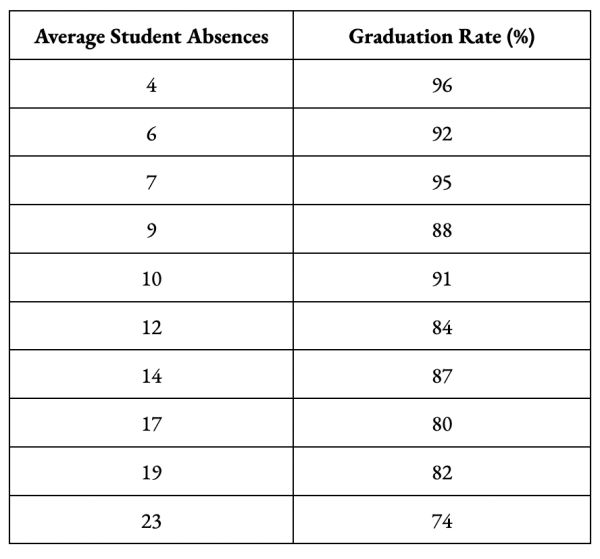
Sample Enrichment: Student Absenteeism and Graduation Rates

You are part of a state education department evaluating whether student absenteeism is related to graduation rates across public high schools. Researchers collected data from several high schools to investigate whether average student absenteeism can be used to predict graduation rates.


The department has gathered the data shown in the table provided.


The department is reviewing a school where students average 14 absences per year and would like to estimate the expected graduation rate using a linear regression model.

Later, the school's actual graduation rate is reported to be 89%.

Before using this model to guide statewide attendance initiatives, the education department asks you to evaluate how well the model performed for this school and what the residual suggests about using absenteeism alone to predict graduation rates.

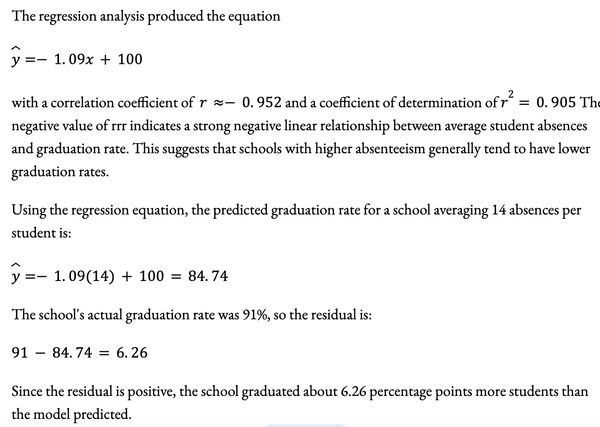
Sample Student Response

Students are expected not only to perform statistical calculations, but also to justify conclusions, communicate evidence, and make recommendations based on their analysis. The response below illustrates that progression.
From Structured Practice to Independent Investigation

Section enrichment tasks are not the end of the learning progression. This is by design.

The tasks provide structured opportunities for students to develop the habits of statistical reasoning before moving to the chapter dataset investigation. In the dataset investigations, students work with authentic state-level data containing multiple variables, imperfect real-world information, and open-ended prompts that require them to decide what questions to investigate, which statistical methods to use, and how to communicate evidence-based conclusions independently.

From Structured Practice to Independent Investigation

Section enrichment tasks are not the end of the learning progression. This is by design.

The tasks provide structured opportunities for students to develop the habits of statistical reasoning before moving to the chapter dataset investigation. In the dataset investigations, students work with authentic state-level data containing multiple variables, imperfect real-world information, and open-ended prompts that require them to decide what questions to investigate, which statistical methods to use, and how to communicate evidence-based conclusions independently.

Explore the Real World Statistics System

Learn More

Interested in the philosophy behind the curriculum?

  • About Real World Statistics → Learn how the instructional system develops statistical reasoning through authentic application and accessible rigor. 
  • About the Author → Meet Nicole Hamilton and learn about the educational philosophy behind the curriculum. 

Interested in learning about how the curriculum is aligned with major curriculum frameworks? 

  • Common Core and AP Alignment → Explore alignment documents showing how the curriculum develops statistical understanding, reasoning, and application.


Copyright © 2026 Simpler Math - All Rights Reserved.

  • Home
  • Books
  • Contact Us
  • Pre-Algebra Videos
  • Blog
  • Algebra 1 Videos
  • Videos
  • Geometry Videos
  • Algebra II & Trig Videos
  • Statistics Videos
  • IB A&I Videos
  • Testimonials
  • Real World Statistics Key
  • Calculator Companion
  • Real World Stats Sample

This website uses cookies.

We use cookies to analyze website traffic and optimize your website experience. By accepting our use of cookies, your data will be aggregated with all other user data.

Accept