

Educational Framework
F.A.S.T. Workflow Design Framework
Developed by Nicole Hamilton
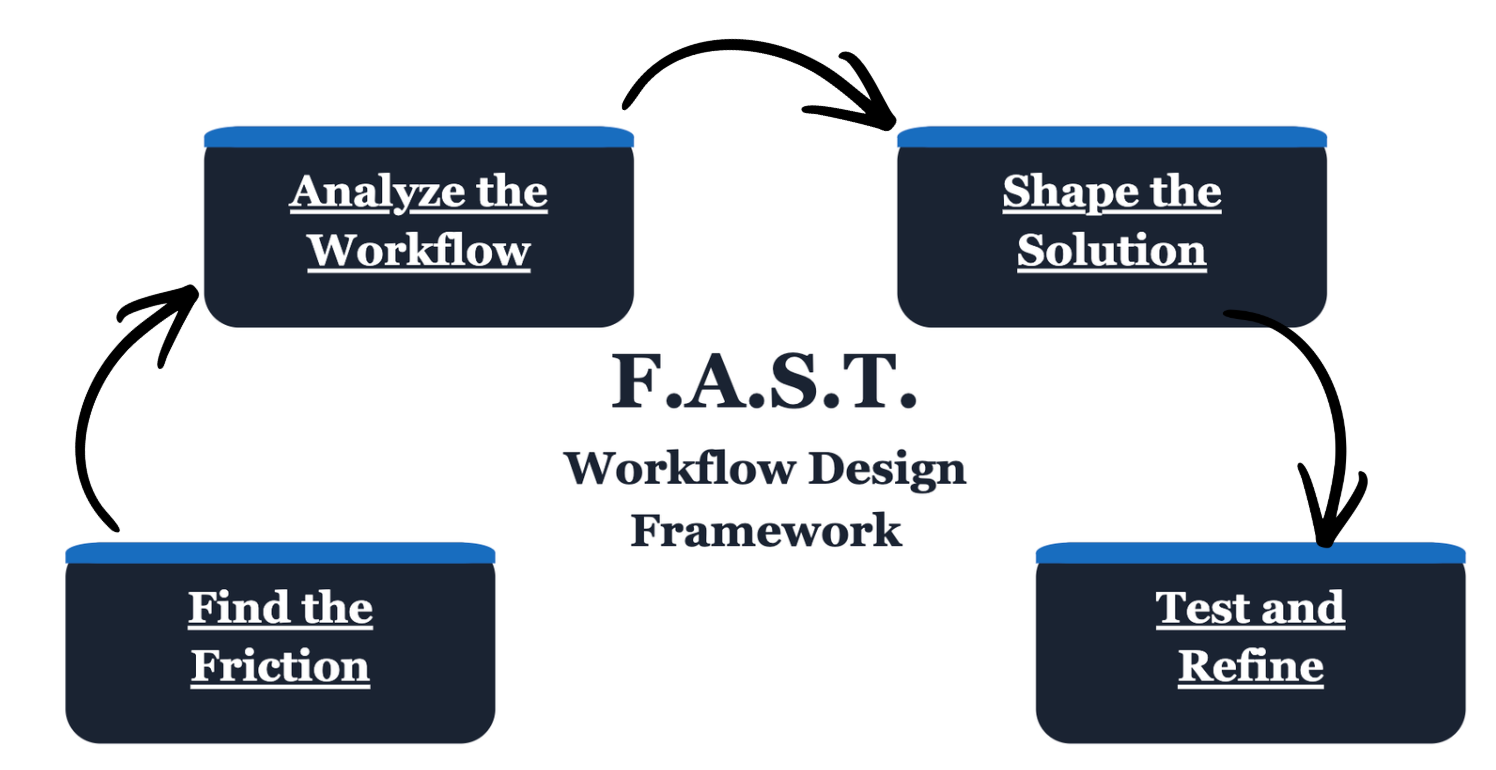
What is the F.A.S.T. Workflow Design Framework?
The F.A.S.T. Workflow Design Framework is a structured approach to improving recurring workflows before building solutions.
Rather than starting with technology, it begins by understanding the work itself.
Whether you're redesigning a faculty process, organizing information, improving communication, or developing a new system, the framework provides a repeatable process for moving from frustration to functional design.
A repeatable process for identifying friction, analyzing current workflows, collaborating with AI to redesign systems, and testing and refining solutions.
The Challenge
Many recurring challenges in schools are not caused by a lack of effort — they're caused by workflows that have evolved over time without being intentionally designed.
Information becomes scattered across multiple systems. Tasks are duplicated. Communication depends on individuals remembering to complete the next step. As new challenges emerge, schools often respond by adding another tool or another process, increasing complexity rather than reducing it.
Before building a solution, it is important to understand how the current workflow functions, where unnecessary friction exists, and what a successful system actually needs to accomplish.
The Framework
The F.A.S.T. Workflow Design Framework is a structured process for redesigning workflows before building solutions. It guides users through four stages:
Find the Friction
Identify where the current process creates unnecessary effort. What breaks down? Where do people work around the system? What information is hard to find or easy to lose?
Analyze the Workflow
Understand what happens now, where breakdowns occur, and what information moves through the process. Map the current state before designing the future state.
Shape the Solution
Use AI to explore workflow designs, systems, and structures that address the identified needs. Collaborate with AI to prototype, pressure-test assumptions, and refine the design.
Test and Refine
Gather feedback, identify gaps, and strengthen the design over time. Effective systems are built iteratively — not launched perfectly.
Examples in Practice
The F.A.S.T. framework has been applied to a range of school workflow challenges. Each example below illustrates how the framework moves a recurring problem toward a functional, sustainable design.
The Role of AI as a Design Partner
AI can accelerate workflow design, but effective systems begin with human understanding of the problem.
The F.A.S.T. framework uses AI during the Shape phase to explore possibilities, identify constraints, test assumptions, and support the design process. The goal is not to replace human decision-making, but to help educators think more expansively about what is possible.
Simpler Math Frameworks
Nicole Hamilton has developed multiple frameworks to support intentional, effective educational design.
F.A.S.T. Workflow Design Framework
A repeatable process for identifying friction, analyzing current workflows, collaborating with AI to redesign systems, and testing and refining solutions.
Current pageAccessible Rigor Framework
A framework for maintaining high expectations while intentionally removing unnecessary barriers to learning.
Interested in applying the F.A.S.T. framework?
Nicole Hamilton works with schools and educators to apply the F.A.S.T. Workflow Design Framework to real challenges. Reach out to start a conversation.